



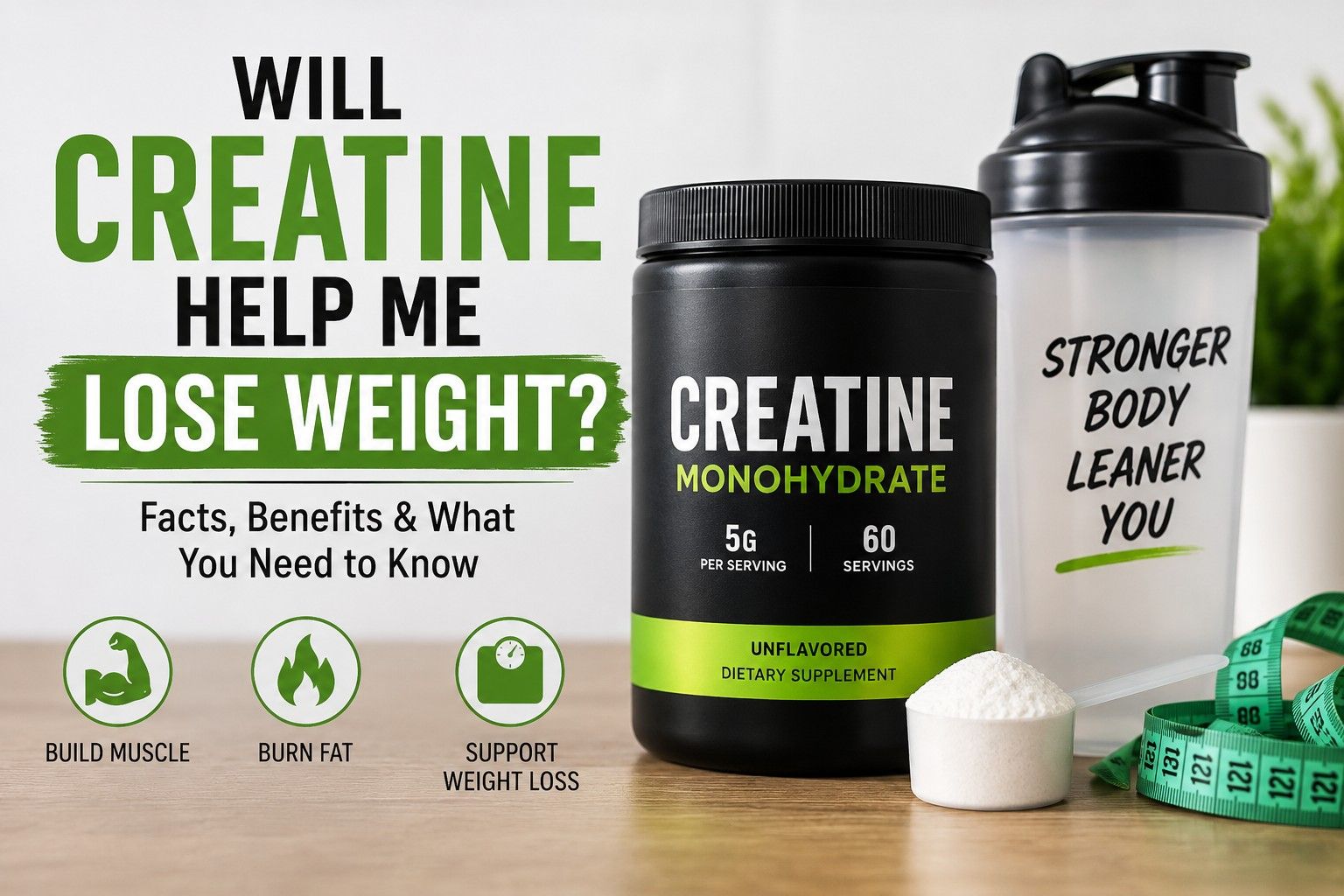
Will Creatine Help Me Lose Weight?
Trying to lose weight while keeping your hard-earned muscle? Will creatine help me lose weight? Creatine may support the muscle-building side of the equation, but it is not a traditional fat-burning supplement.
Will creatine help me lose weight? It is a common question among people who want to improve body composition while dieting or exercising. The short answer is that creatine does not directly burn large amounts of body fat. However, research suggests it can increase lean body mass and may slightly improve body-fat measures, particularly when combined with resistance training.
That distinction matters because losing weight and losing body fat are not exactly the same thing. Creatine can sometimes increase scale weight because it increases water associated with muscle and supports lean-mass gains. Therefore, someone taking creatine might see the scale move differently even while making progress.
What Is Creatine?
Creatine is a compound naturally found in the body and in foods such as meat and fish. Your muscles store creatine and use it to help produce energy during short, intense activities such as weightlifting, sprinting, and resistance exercises.
Because of this role, creatine has become one of the most widely studied sports supplements. Its primary purpose is not weight loss. Instead, it is generally used to support exercise performance, strength, and lean muscle development.
Consequently, creatine can become relevant during a weight-loss program when preserving muscle is one of your goals.
Will Creatine Help Me Lose Weight?
The answer depends on what you mean by “lose weight.”
If you mean make the number on the scale drop quickly, creatine is not likely to help. In fact, the opposite can happen initially because creatine supplementation can increase body mass.
If your goal is reduce body fat while maintaining or building lean muscle, creatine may have a useful supporting role.
A 2024 systematic review and meta-analysis involving 143 studies found that creatine supplementation increased body mass and fat-free mass while producing a small reduction in body-fat percentage. The researchers also found that the effects were more pronounced when creatine was combined with resistance training.
Another 2024 meta-analysis specifically examining creatine alongside resistance training found an average increase of about 1.14 kg in lean body mass and small reductions in body-fat percentage and fat mass compared with resistance training alone.
So, rather than thinking of creatine as a fat burner, it is more accurate to view it as a supplement that may support a better body-composition outcome.
Does Creatine Burn Fat?
Creatine should not be marketed as a direct fat-burning supplement.
Your body loses fat primarily when you maintain an appropriate calorie deficit over time. Diet, physical activity, resistance training, sleep, and overall consistency have much larger roles in determining whether you lose body fat.
However, creatine may indirectly support your results.
It May Help You Train Harder
Resistance training is valuable during weight loss because it can help preserve lean tissue. Research suggests that resistance exercise during dietary weight loss can protect fat-free mass, increase fat-mass loss, and improve muscular strength.
Creatine can complement this type of training by supporting strength and exercise performance.
It May Support Muscle Retention
When you reduce calories, some people lose both fat and lean tissue. Maintaining muscle can therefore become an important part of a successful weight-loss plan.
Creatine supplementation has consistently been associated with increases in lean body mass, particularly when combined with resistance training.
As a result, your goal should not necessarily be to make the scale fall as quickly as possible. Instead, aim for gradual fat loss while maintaining as much lean muscle as possible.
Can Creatine Make You Gain Weight?
Yes, and this is one of the most important things to understand before starting it.
Creatine can increase body weight even when you are not gaining body fat. The increase is associated largely with water and increases in fat-free mass.
A large 2024 meta-analysis found an average increase in body mass of about 0.86 kg across the included creatine studies, alongside an increase in fat-free mass.
Therefore, don’t automatically assume that a higher scale reading means you gained fat.
For example, imagine someone starts a calorie-controlled diet and resistance-training program while taking creatine. Their body weight might remain stable for a period, while their waist measurement decreases and their strength improves.
That can still represent meaningful progress.
Creatine and Water Weight
Water weight is one reason the scale can become confusing after starting creatine.
Creatine is stored in muscle, and increased muscle creatine storage is associated with changes in water distribution. Consequently, some people notice a temporary increase in scale weight after beginning supplementation.
This does not mean creatine has caused fat gain.
For someone focused on fat loss, it can therefore be helpful to monitor several measurements rather than relying exclusively on body weight.
Consider tracking:
- Waist circumference
- Body weight trends
- Progress photos
- Strength in the gym
- How clothing fits
- Body-fat measurements when reliable
Looking at several indicators gives you a more complete picture.
Creatine for Weight Loss: What Does the Research Say?
The research is promising but should not be exaggerated.
A 2024 meta-analysis of adults younger than 50 found that creatine combined with resistance exercise produced a very small reduction in body-fat percentage, but it did not find a significant difference in absolute fat mass.
Another recent meta-analysis of 61 trials found that creatine plus resistance training increased fat-free mass and body mass but did not find significant overall effects on fat mass, BMI, or body-fat percentage.
Why do results differ?
Studies use different doses, training programs, durations, populations, diets, and methods of measuring body composition. Therefore, it would be misleading to promise that creatine will cause significant fat loss.
The more consistent finding is that creatine can help support lean-mass gains, especially when paired with resistance training.
How to Use Creatine During Weight Loss
If you decide to use creatine while trying to lose body fat, keep the overall strategy simple.
1. Prioritize Your Diet
Creatine cannot compensate for consistently eating more calories than your body needs.
Build meals around protein-rich foods, vegetables, fruits, whole grains, and appropriate portions. Then create a sustainable calorie deficit if fat loss is your goal.
2. Perform Resistance Training
This is particularly important because much of the evidence supporting creatine’s body-composition benefits involves resistance exercise.
Aim for a consistent strength-training routine that works the major muscle groups.
3. Get Enough Protein
Protein provides amino acids needed to build and maintain muscle. During weight loss, getting adequate protein becomes especially useful when combined with resistance training.
Good choices include eggs, poultry, fish, Greek yogurt, cottage cheese, beans, lentils, tofu, and other protein-rich foods.
4. Stay Consistent
Creatine is not a quick-fix supplement.
Your results will depend much more on your overall eating pattern, exercise routine, recovery, and adherence over weeks and months.
What Type of Creatine Should You Choose?
Creatine monohydrate is the form most commonly used in research and is generally the simplest choice.
You do not necessarily need an expensive creatine blend or a product with numerous added ingredients.
If you are considering supplementation, follow the product’s directions and speak with a healthcare professional if you have a medical condition, take medications, are pregnant or breastfeeding, or have concerns about whether creatine is appropriate for you.
Common Mistakes to Avoid
Expecting Creatine to Melt Fat
Creatine is not a magic fat burner. If your diet and activity level do not support fat loss, taking creatine alone is unlikely to change that.
Stopping Because the Scale Goes Up
Creatine may cause a temporary increase in body weight due to increased water and lean muscle mass. So, focus on overall body composition and progress rather than relying only on the scale.
Ignoring Resistance Training
If your goal is better body composition, combine your nutrition strategy with regular resistance exercise rather than depending on supplementation alone.
Using Too Many Supplements
More supplements do not automatically mean faster results. Start with the fundamentals first: calorie control, nutritious food, protein, exercise, sleep, and consistency.
Can Creatine Help With Belly Fat?
Creatine should not be considered a targeted belly-fat supplement.
Unfortunately, you cannot choose exactly where your body loses fat. Genetics, hormones, age, sex, and overall energy balance influence fat distribution and loss.
However, combining a calorie-controlled diet with resistance training can help improve overall body composition. Creatine may support the training and lean-mass side of that strategy.
So, if your goal is a smaller waist, focus on overall fat loss rather than trying to find a supplement that specifically burns belly fat.
Should You Take Creatine While Trying to Lose Weight?
For many healthy adults who resistance train, creatine can be a reasonable supplement to consider. The strongest reason to use it during a weight-loss phase is not because it directly causes dramatic weight loss.
Instead, it may help support lean mass and training performance.
That can be valuable because preserving muscle while reducing body fat can produce a better body-composition result than simply chasing the lowest possible scale weight.
Still, individual circumstances matter. If you have kidney disease, another medical condition, or take medications that could affect kidney function or fluid balance, discuss creatine supplementation with a healthcare professional before using it.
What Should You Track Instead of Just Weight?
When using creatine during a fat-loss program, consider measuring progress every few weeks.
Body Weight
Use weekly trends rather than reacting to one day’s number.
Waist Size
A decreasing waist measurement can be encouraging even when body weight changes slowly.
Strength
If your strength is stable or improving while you’re losing fat, that can be a useful sign that you are maintaining muscle.
Photos
Take photos under similar lighting, clothing, and conditions. Changes can be easier to notice over several weeks.
How You Feel
Energy, recovery, hunger, sleep, and workout performance also matter when evaluating whether your weight-loss plan is sustainable.
Final Answer: Will Creatine Help Me Lose Weight?
So, will creatine help me lose weight? Not directly in the way a fat-burning supplement is often advertised.
Creatine can increase body weight because of changes in water and lean mass. At the same time, research shows that it can increase fat-free mass and may produce small improvements in body-fat measures, particularly when combined with resistance training.
Therefore, if your goal is fat loss while maintaining muscle, creatine may be useful as part of a bigger strategy. However, your main priorities should remain a sustainable calorie deficit, adequate protein, resistance training, regular movement, good sleep, and consistency.
In other words, don’t take creatine expecting the scale to drop faster. Use it, when appropriate, as a tool that may help you train and maintain lean mass while your overall plan does the work of reducing body fat.
A Weight-Loss Product to Consider
Lanta Flat Belly Shake is a convenient shake option for people looking to support their weight-management routine. It can be positioned as a convenient addition to a balanced diet and regular exercise rather than as a replacement for healthy eating habits.
👉 Learn more about Lanta Flat Belly Shake and see whether it fits your weight-loss goals.